

IPv6: Unlocking the Future of Internet Infrastructure
Table of contents
The global internet infrastructure stands at a pivotal crossroads. As we advance deeper into the digital age, the limitations of IPv4 are becoming increasingly apparent, while IPv6 emerges as the essential foundation for tomorrow’s connected world. For telecommunications operators and their enterprise clients, the transition to IPv6 is no longer a question of “if” but “when” — and the evidence overwhelmingly suggests that “when” is now.
IPv6: A Protocol Born from Necessity
IPv6’s journey began in the early 1990s when the Internet Engineering Task Force (IETF) recognized that IPv4’s 32-bit addressing system would eventually reach exhaustion.
The protocol was formally standardized in December 1998 with RFC 2460, and by July 2017, IPv6 achieved “Internet Standard” status — the highest maturity level for IETF protocols.
This wasn’t merely a technical upgrade; it represented a fundamental reimagining of how internet addressing should work in an increasingly connected world.
The IPv4 Exhaustion Crisis: A Catalyst for Change
The theoretical concerns of the 1990s became harsh reality in the 2010s. On February 3, 2011, IANA (Internet Assigned Numbers Authority) allocated the last remaining IPv4 address blocks to the Regional Internet Registries (RIRs), marking the official exhaustion of the global IPv4 pool. This watershed moment sent shockwaves through the networking industry.
By 2015, APNIC (Asia-Pacific) had depleted its reserves, followed by ARIN (North America) in September 2015, LACNIC (Latin America) in 2020, and RIPE NCC (Europe) in November 2019.This scarcity transformed IPv4 addresses into valuable commodities, with prices soaring from a few dollars to $40-50 per address on secondary markets by 2025.
The economic pressure, combined with the operational complexities of Carrier-Grade NAT (CGNAT) deployments needed to stretch remaining IPv4 resources, forced the industry’s hand.
Network equipment manufacturers prioritized IPv6 feature parity in their hardware and firmware. Software vendors rushed to eliminate bugs and improve IPv6 stack performance. Major operating systems — from Windows and Linux to iOS and Android — achieved robust dual-stack capabilities. What had been treated as a “nice-to-have” feature suddenly became mission-critical, driving a dramatic improvement in IPv6 implementation quality across the entire ecosystem.
The transition from IPv4 to IPv6 addresses one of the most pressing challenges facing modern networks: address scarcity. IPv4’s theoretical maximum of 4.3 billion addresses seemed infinite in the 1980s, but the explosion of mobile devices, Internet of Things (IoT) applications, and always-on broadband connections quickly consumed this finite resource.
IPv6, in contrast, utilizes 128-bit addressing, providing approximately 340 undecillion unique addresses — enough to assign roughly 100 addresses for every atom on Earth’s surface. This vast address space isn’t just about quantity; it fundamentally changes how we approach network design, eliminating the need for Network Address Translation (NAT) and enabling true end-to-end connectivity.
IPv6 vs. IPv4
At their core, IPv4 and IPv6 are fundamentally distinct in their design, capabilities, and operational philosophy. Beyond the most prominent difference — IPv6’s vast 128-bit addressing space versus IPv4’s 32 bits — there are several additional technical enhancements that make IPv6 the protocol of the future.
Addressing the Conspiracy
Some skeptics claim IPv6 was promoted by intelligence agencies as a surveillance enhancement tool. This theory collapses under scrutiny: the FBI and DEA testified before Congress in 2012 expressing concern that IPv6’s enormous address space would hinder criminal investigations by making network scanning impractical.
Moreover, IPv6’s RFC 4941 privacy extensions — which generate temporary, randomized addresses — were specifically designed to prevent device tracking. If anything, IPv6 offers better privacy protections than IPv4’s forced reliance on carrier-grade NAT, where ISPs can correlate all user activities.
Now, let’s examine the real reasons why IPv6 matters.
Address Assignment and Autoconfiguration
While IPv4 typically relies on DHCP (Dynamic Host Configuration Protocol) or manual assignment for IP address configuration, IPv6 introduces Stateless Address Autoconfiguration (SLAAC).
This feature allows IPv6-enabled devices to generate their own unique addresses automatically by combining local network prefixes with interface identifiers, eliminating the need for a central server in many environments and streamlining network deployment and scaling.
Header Structure and Extension Headers
IPv6 simplifies the standard IP header by removing rarely-used fields, making parsing more efficient for routers. The protocol moves optional information out of the main header and places it in separate extension headers that are only processed by nodes that need them. This modular approach enables greater flexibility and efficiency in packet processing, and lays the groundwork for advanced functionality and improved performance.
Routing & Aggregation
With global public addressing and hierarchical address allocation, IPv6 allows for more efficient routing aggregation, reducing the size of global routing tables. Its address format supports large contiguous address blocks, enabling ISPs and enterprises to optimize their routing infrastructure and simplify policy-based routing. This is especially beneficial for large-scale data centers and providers with complex network topologies.
👉 Many ISPs use MPLS or EoMPLS for efficient traffic delivery, including IPv6 networks
Security Approaches
Security in IPv6 was designed as an integral feature, not an add-on. The protocol requires support for IPsec (IP Security), which provides authentication, integrity, and confidentiality at the network layer. While IPsec can also work with IPv4, its implementation is mandatory in IPv6, thus encouraging end-to-end encryption as a standard practice. Additionally, IPv6 offers improved privacy through temporary addresses and prefix randomization, helping mitigate certain tracking and reconnaissance techniques.
Address Allocation from RIRs
IPv6’s abundance of address space has transformed the allocation process through Regional Internet Registries (RIRs). Unlike the tightly rationed and often expensive IPv4 allocations, obtaining IPv6 prefixes from RIRs is straightforward, cost-effective, and allows for generous block sizes, facilitating growth and robust future planning for providers and end users alike.
This ease of allocation removes bottlenecks for expanding networks and reduces the operational headaches associated with IPv4 address scarcity.
These enhancements position IPv6 as a modern, scalable, and secure protocol, ideally suited for the explosive growth of devices and services that define today’s and tomorrow’s internet.
Current Global Adoption
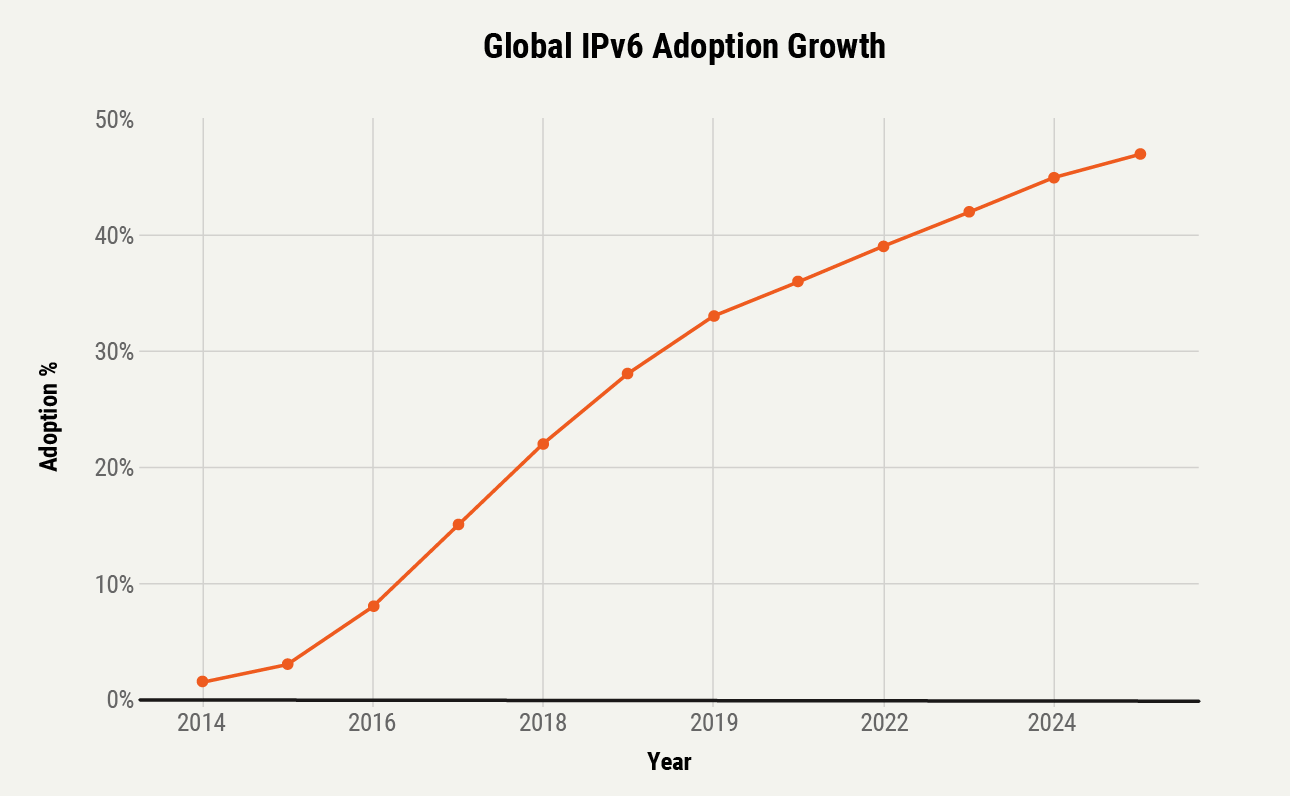
The data reveals a compelling story of accelerating IPv6 adoption worldwide. Global deployment has grown from less than 1% in 2014 to approximately 45-50% by 2025, with some regions showing even more dramatic progress. The Asia-Pacific region has emerged as a leader, with APNIC economies achieving 50% IPv6 capability in 2025 — a milestone representing 25 years of development since the region first began its IPv6 journey.
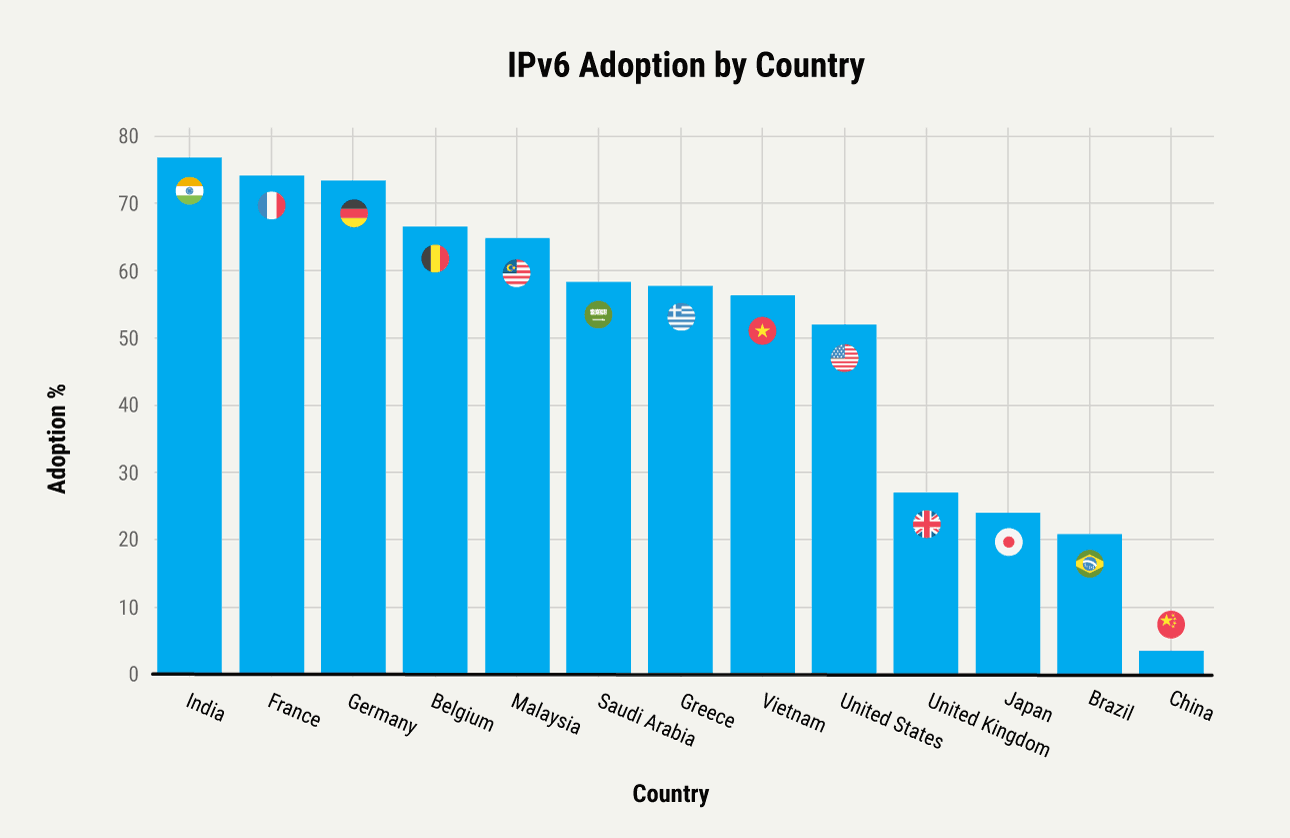
Country-level adoption varies significantly, revealing both opportunities and challenges. India leads globally with 76.9% IPv6 deployment, followed closely by France at 74.3% and Germany at 73.3%. These success stories demonstrate that widespread IPv6 adoption is not only possible but practical at national scale.
France’s achievement is particularly noteworthy, driven primarily by mobile network operators increasing IPv6 subscriptions and strong support from major Internet Service Providers.
The United States presents an interesting case study, with IPv6 adoption reaching approximately 52% despite earlier slow progress. This improvement reflects concentrated efforts by major carriers and ISPs, including Comcast (65% deployment).
The cloud computing and hosting industry has emerged as a powerful driver of IPv6 adoption. Amazon Web Services (AWS) began offering IPv6 support in 2011 and has progressively expanded it across its global infrastructure, enabling customers to deploy IPv6-only workloads and dual-stack configurations. Microsoft Azure has similarly embraced IPv6 across its cloud services, providing native IPv6 connectivity for virtual machines, load balancers, and other core services since 2012.
Google Cloud Platform has integrated IPv6 support throughout its ecosystem, with Google itself pioneering IPv6 deployment across its search, advertising, and content delivery networks as early as 2008.
Content delivery networks and edge providers have also played a crucial role. Cloudflare enabled IPv6 by default for all customers in 2012, making it one of the easiest ways for websites to gain instant IPv6 connectivity. Akamai, controlling a significant portion of global web traffic, has maintained extensive IPv6 deployment since 2010, ensuring that content reaches users over both protocols seamlessly.
These infrastructure providers have effectively removed technical barriers for their customers, allowing even small businesses and startups to deploy IPv6-capable services without specialized expertise.
The hosting and data center sector has followed suit, with major players recognizing that IPv6 support is no longer optional. LinkedIn transitioned to IPv6-only data centers in 2016, demonstrating that enterprise-scale infrastructure can operate efficiently without IPv4 internally, using translation technologies only at the network edge where necessary. This “IPv6-only with IPv4-as-a-Service” model represents the future of data center design, reducing operational complexity and costs while future-proofing infrastructure.
IPTP Networks: Your Partner in the IPv6 Transition
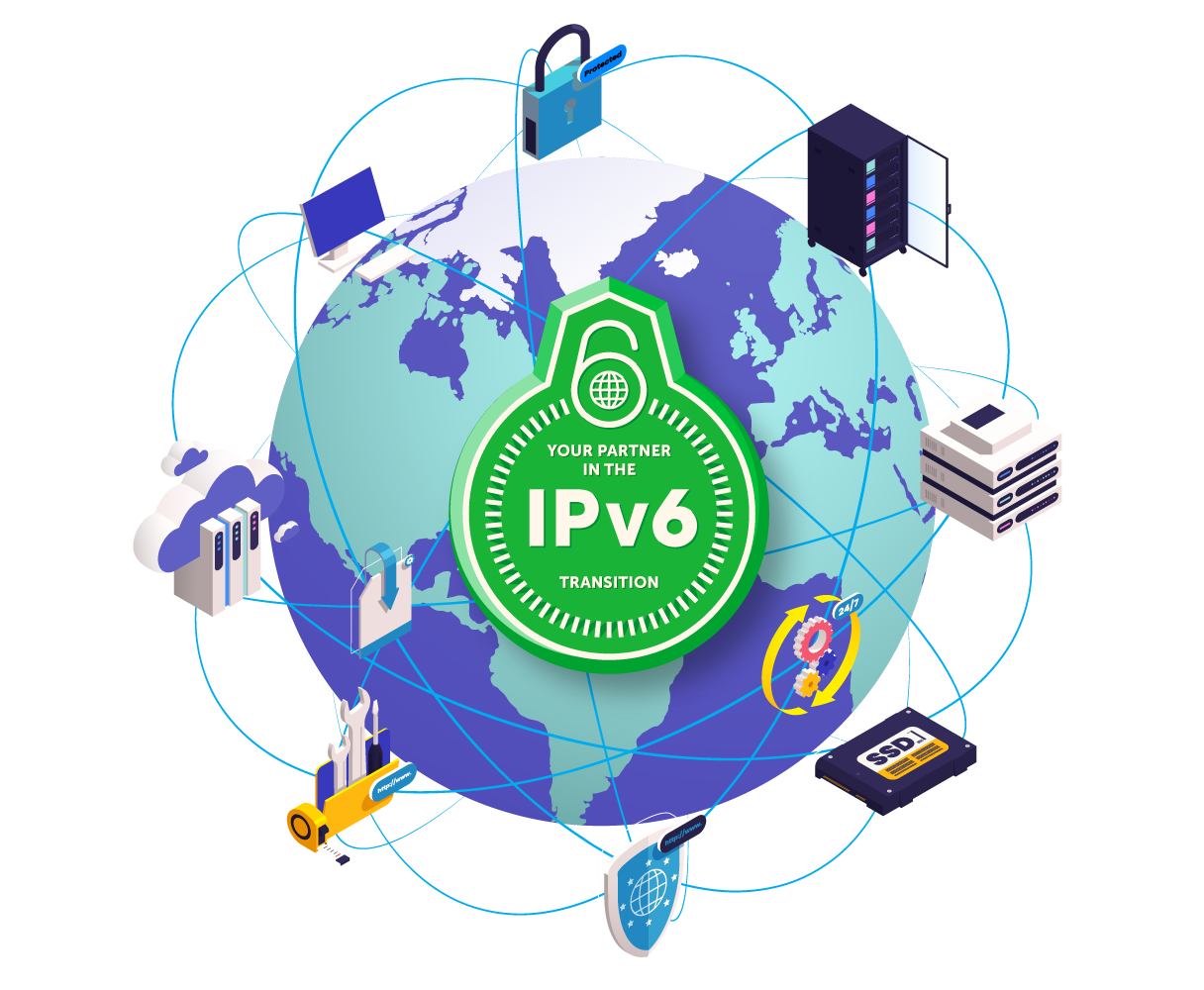
As the global internet infrastructure undergoes this fundamental transformation, IPTP Networks stands positioned as a trusted guide through the IPv6 transition.
With extensive experience deploying IPv6 across diverse markets and geographies, we bring connectivity solutions to customers in both leading IPv6 adoption regions — such as India, France, and Germany, where deployment rates exceed 73% — and in emerging markets where IPv6 infrastructure is still taking root. This dual expertise enables us to serve customers at every stage of their IPv6journey, regardless of their current network maturity.
Our infrastructure provides direct connectivity to the world’s leading cloud providers — Amazon AWS, Microsoft Azure, and Google Cloud Platform — all of which offer comprehensive IPv6 support across their services.
This means your organization can seamlessly deploy IPv6-capable applications and services without architectural limitations, leveraging our global network as a bridge to the future-ready cloud ecosystem. Whether you’re running dual-stack infrastructure or planning a transition to IPv6-only deployments, our backbone is engineered to support both present and future connectivity models.
But connectivity is only the beginning. IPTP Networks provides more than just pipes — we provide expertise. Our team has successfully helped numerous enterprises, ISPs, and data center operators implement IPv4/IPv6 services — from initial planning and addressing strategy to full-scale deployment and optimization.
We understand the unique challenges facing organizations at different stages of adoption: the technical hurdles of legacy equipment, the operational complexities of dual-stack management, and the strategic planning required for long-term IPv6-only infrastructure. Whether you’re taking your first steps toward IPv6 or accelerating your transition to next-generation networking, IPTP
Networks are committed to supporting your organization every step of the way, ensuring a smooth, cost-effective, and future-proof evolution of your network infrastructure.