


Remote DIA vs. VPN over Internet: Why Simple Wins
Table of contents
You’ve probably been there: rolling out VPN connectivity for your company, dealing with the usual headaches. Users complain about slow speeds. Netflix blocks your VPN IPs. Conferences drop in the middle of important calls. And then there’s that time when your VPN provider’s entire infrastructure went down, taking your business with it.
Here’s the thing: VPN over the public internet introduces layers of complexity that create real operational problems. Let’s talk about why, and what the alternative looks like.
What We’re Actually Comparing
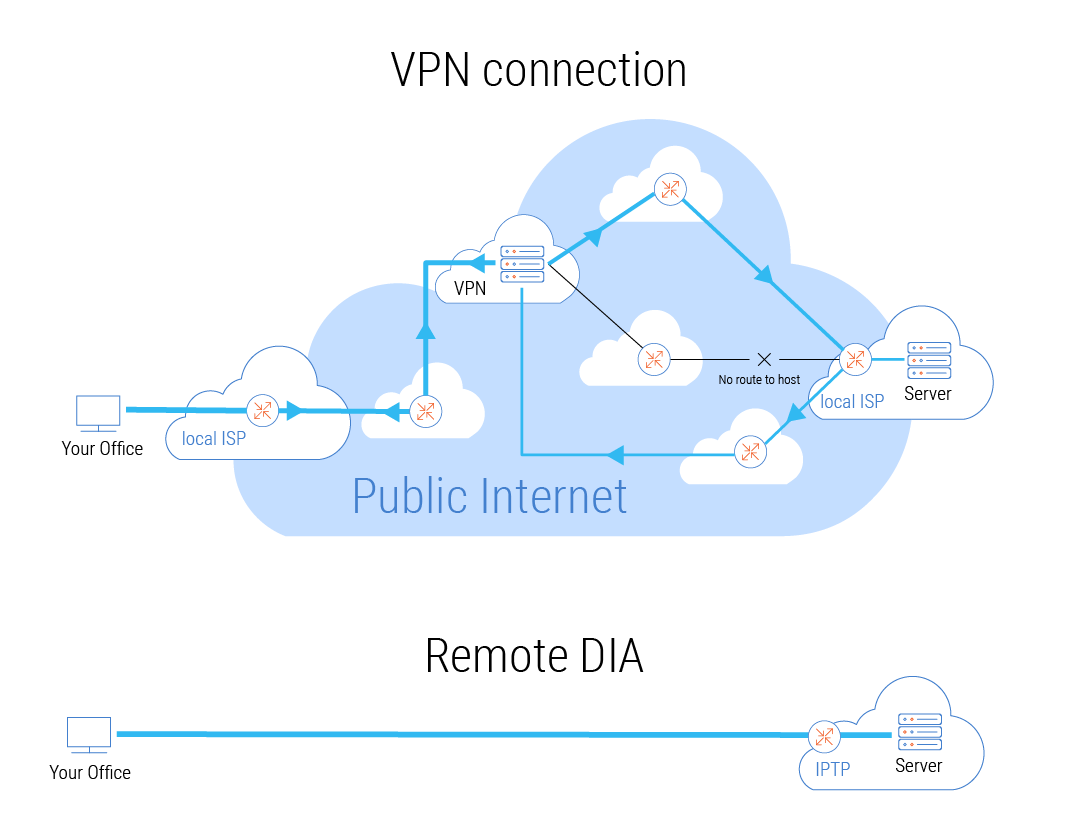
VPN over Internet means you purchase regular internet access in your office, then create encrypted tunnels through the public internet to VPN servers in another country. Your traffic bounces through multiple networks you don’t control before emerging with a foreign IP address.
Remote Direct Internet Access (Remote DIA) is simpler: you buy internet access directly in the target country and connect to it with a clean, dedicated link. No tunnels, no encryption overhead, no complexity. Your traffic exits to the internet as if your office physically sits in that country.
Think of it this way: VPN is like mailing a locked box through the postal system, hoping it arrives intact. Remote DIA is like having a direct pipe between your office and the destination — nothing in between.
The Real Costs of VPN Complexity
VPNs over the public internet seem simple and accessible solutions, but the real costs show up in day-to-day operations: inconsistent performance, wasted bandwidth from encryption overhead, shared IP reputation issues, and slow, multi-party troubleshooting when something breaks. The sections below break down where VPN complexity creates measurable business impact—and why Remote DIA delivers more predictable results.
Performance Unpredictability
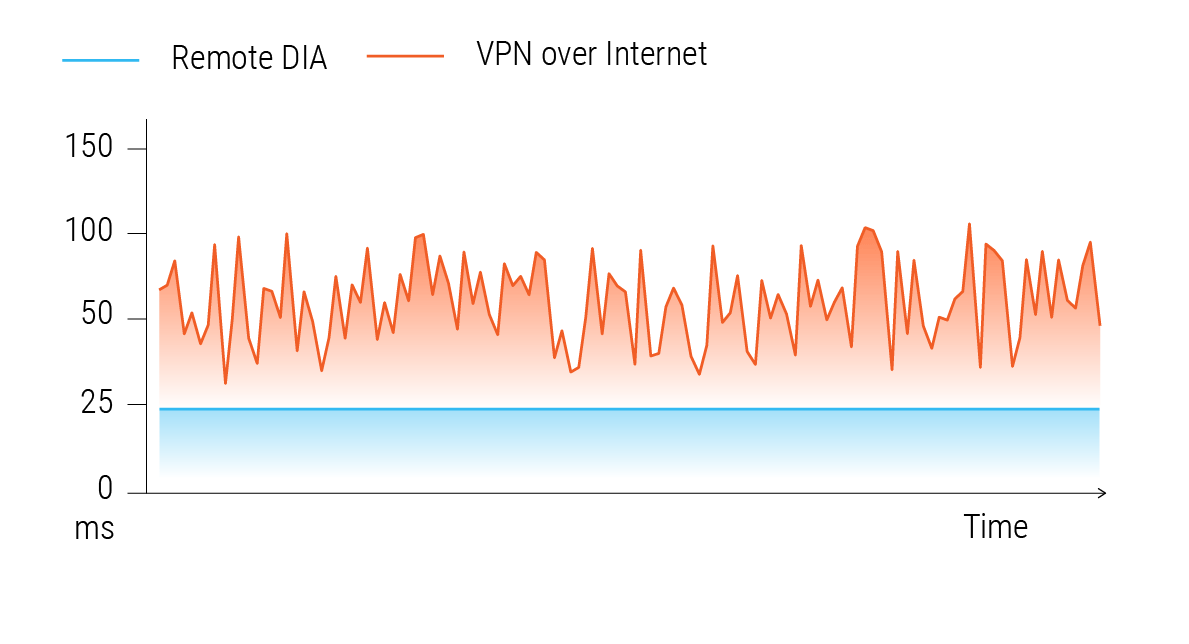
With VPN over the internet, you’re dependent on public internet routing. Your traffic might take an efficient path today and route through three extra countries tomorrow. That typical connection inside a region could be 50ms one hour and 150ms the next.
Remote DIA gives you the physics-limited best case: approximately 25-30ms for the same connection, consistently. No routing mysteries, no congestion surprises.
The Encryption Tax
Every VPN adds processing overhead. Modern implementations are efficient, but you still lose 20-50% of your bandwidth to encryption and protocol overhead. Buy a 500 Mbps internet connection, get 250-400 Mbps actual throughput through the VPN.
Remote DIA? Line-rate performance. 1 Gbps circuit delivers 1 Gbps of usable bandwidth. Simple.
IP Reputation Problems
Streaming services block VPN IPs aggressively. Netflix maintains blacklists of VPN provider address ranges. Your employees trying to access legitimate services get blocked because you share IP space with thousands of other VPN users.
Remote DIA gives you clean IPs from a legitimate carrier in the target country. Nobody blocks carrier infrastructure.
Troubleshooting Nightmares
When a VPN connection fails, where’s the problem? Your local internet? The VPN provider’s server? Internet routing between them? The VPN software? The firewall configuration? You’re coordinating between multiple parties, none of whom can see the full picture.
Remote DIA troubleshooting is straightforward: is the circuit up? If yes, you’re good. If no, you call one carrier. They own the entire path and can diagnose it.
Hidden Operational Costs
VPN services look cheap on paper — few dollars per user per month. But that’s just the subscription. You also pay for:
- Staff time managing VPN client deployments and updates
- Help desk tickets for connection issues
- Bandwidth overhead reducing effective throughput
- Security team effort monitoring encrypted tunnels
- Lost productivity during outages
These hidden costs often exceed the subscription price.
Why Remote DIA Makes Sense
Remote DIA isn’t a “more expensive VPN” — it’s a different access model: a dedicated circuit in the target country with controlled performance and end-to-end carrier accountability. Instead of trying to “fix” the public internet with tunnels, you buy predictability: guaranteed bandwidth, measurable quality metrics, and contractual SLAs. Below are the key reasons Remote DIA delivers consistent performance, enforceable guarantees, and a simpler network architecture.
Predictable Performance
When you purchase a 1 Gbps Remote DIA circuit, you get 1 Gbps symmetric, guaranteed. The carrier gives you an SLA — typically 99.9% to 99.99% uptime with financial penalties if they miss it. Your latency is fixed by physics: the speed of light through fiber.
No shared resources, no contention, no surprises.
Real SLAs With Teeth
Consumer VPNs offer no SLAs. Enterprise VPNs provide limited platform availability guarantees but can’t control the underlying internet. When a problem occurs, you get apologies, not service credits.
Remote DIA contracts specify:
- Maximum packet loss (typically <0.1%)
- Guaranteed bandwidth (symmetric, committed)
- Maximum latency
- Mean time to repair (often 4-24 hours)
- Financial penalties for violations
These aren’t marketing promises—they’re contractual obligations.
Simplified Architecture
Remove the VPN layer entirely. Your network connects directly to internet access in the target country via a dedicated link — could be Layer 2 Ethernet, Layer 3 IP, or MPLS. No encryption handshake complexity, no tunnel management, no client software.
From a network operations perspective, it’s just another WAN link. Your existing tools monitor it. Your existing team manages it. Nothing special.
Native Internet Experience
With Remote DIA, your traffic emerges from a proper carrier in the target country. Services see legitimate enterprise IPs, not VPN pool addresses. Content delivery networks (CDNs) route you to nearby caches.
Latency-sensitive applications work correctly.
You get the internet experience of actually being in that country, because from the internet’s perspective, you are.
Real-World Scenarios
The choice between VPN and Remote DIA depends on what your business is optimizing for: latency stability, throughput, compliance, and operational simplicity versus cost. Below are real-world examples across industries—where Remote DIA is essential (because performance and guarantees directly affect revenue or risk), and where a VPN is perfectly sufficient.
Financial Services: When Milliseconds Matter
A trading firm in Singapore needs access to the London Stock Exchange. Every millisecond of latency costs money — literally hundreds of thousands of dollars annually in reduced trading alpha.
VPN over the internet introduces variable 100-350ms latency with unpredictable jitter. The encryption overhead adds another 1-5ms. On bad days, internet routing takes wild detours.
Remote DIA with optimized fiber routing delivers consistent 79-84 ms. No encryption overhead. No routing surprises. The firm’s algorithms can count on that latency when executing strategies.
Financial regulations also matter: MiFID II requires strict controls and audit trails. SEC Rule 613 mandates 50-microsecond timestamp accuracy with $1 million daily fines for non-compliance. You can’t meet these requirements with “best effort” VPN service.
Result: Financial services universally deploy Remote DIA for trading connectivity. VPN isn’t even considered.
Media Production: Moving Terabytes Daily
A post-production studio needs to transfer 4K video dailies — 50-100 TB per day — between production office and cloud storage.
Over VPN on a 1 Gbps internet connection, you’re realistically getting 500-700 Mbps after encryption overhead. That’s 160-220 hours to transfer 100 TB. Nearly 10 days. Unacceptable for daily workflows.
Remote DIA with a 10 Gbps circuit delivers line-rate 10 Gbps symmetric. That’s 22 hours for 100 TB — fits overnight transfer windows. Consistent, predictable, reliable.
Corporate Office: The Middle Ground
A 200-person software company wants employees to access SaaS applications “as if” they’re in Europe for compliance reasons.
VPN makes sense here. Applications like email, Slack, and Jira tolerate latency. Bandwidth requirements are modest — 100-200 Mbps aggregate. The $5-10 per user VPN cost ($12,000-24,000/year) is reasonable.
Remote DIA would work but costs annually for circuit, backhaul, and equipment. That’s 3-10x more expensive for no meaningful benefit given the use case.
This company should use VPN. Not everything needs enterprise-grade dedicated connectivity.
The Regulatory Dimension
Regulatory requirements often matter more than performance. The moment user traffic crosses borders, you need to think about lawful basis, documentation, and who you’re contracting with. Remote DIA doesn’t remove compliance obligations, but it can reduce ambiguity because you’re working with licensed carriers and clear service terms instead of consumer-grade VPN providers. The sections below outline the practical considerations by region.
EU/UK: Data Protection Considerations
Under GDPR, routing employee traffic through third countries requires legal basis. Whether using VPN or Remote DIA, you need:
- Data Protection Impact Assessment (DPIA) documenting the flows
- Standard Contractual Clauses (SCCs) with carriers/providers
- Audit trail showing compliance controls
Remote DIA simplifies this somewhat — you’re contracting with a regulated carrier, not a consumer VPN service. The carrier’s operations are auditable and documented. GDPR compliance is still required, but the framework is clearer.
US/Asia: Standard Telecommunications
Remote DIA to the US, Singapore, or other business-friendly jurisdictions is standard telecommunications service. No special restrictions, though industry-specific requirements apply (HIPAA for healthcare, PCI-DSS for payments, FINRA for finance).
China requires licensed carriers for international circuits and prohibits using them for general circumvention. You work with state-approved carriers and document corporate use.
When to Choose What
There isn’t a single “best” option — VPN and Remote DIA solve different problems. The right choice comes down to a few practical factors: how sensitive you are to latency and jitter, how much data you move, what level of uptime you must guarantee, and whether compliance requires auditable, carrier-grade connectivity. Use the checklist below to match the approach to your use case and budget.
Use Remote DIA when:
- Your applications are latency-sensitive: trading, real-time analytics, VoIP infrastructure
- You transfer large data volumes regularly: video production, scientific computing, backup/DR
- Performance directly impacts revenue: every millisecond costs money
- You need contractual SLAs with financial penalties
- Regulatory compliance requires dedicated, auditable infrastructure
- You’re operating in regulated industries: finance, healthcare, critical infrastructure
- Budget supports high annual per-site connectivity costs
Use VPN over Internet when:
- Supporting distributed remote workers or temporary operations
- Applications tolerate latency and variable performance: email, web browsing, most SaaS
- Bandwidth needs are modest: under hundreds Mbps aggregate
- Budget constraints require cost-effective solutions
- You need rapid deployment: hours instead of weeks
- Testing market presence before infrastructure commitment
- Risk tolerance accepts variable performance
Consider hybrid approach when:
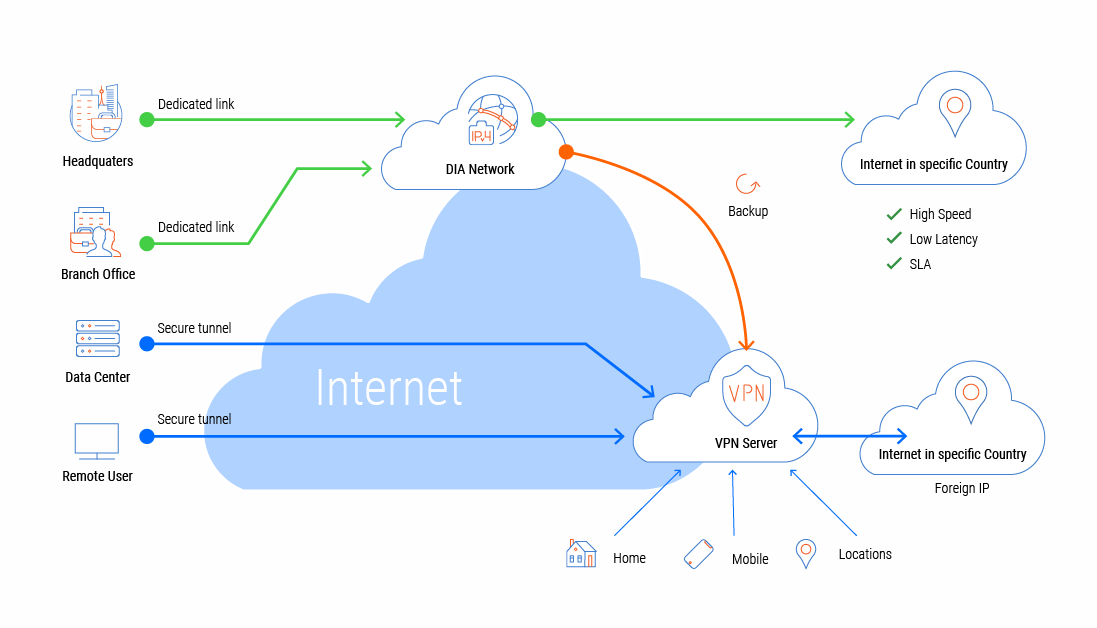
- Core site-to-site connectivity requires Remote DIA performance
- Remote workers can use cost-effective VPN
- Critical applications need guaranteed performance, others don’t
- Redundancy matters: DIA as primary, VPN as backup
- Progressive scaling as business grows
Summary
Remote DIA isn’t “better” than VPN — it’s different. It solves different problems at different price points.
VPN over the internet introduces complexity: encryption overhead, unpredictable routing, shared infrastructure, IP reputation issues, difficult troubleshooting. For many use cases, this complexity is manageable and the cost savings justify it.
Remote DIA eliminates that complexity by giving you direct, dedicated internet access in the target location. You pay significantly more, but you get predictable performance, contractual SLAs, simplified operations, and clean IP reputation.
The question isn’t “which is better?” It’s “what does your business actually need?”
If you’re running latency-critical trading systems or transferring hundreds of terabytes weekly, Remote DIA isn’t optional — it’s the only viable solution. If you’re supporting remote workers accessing SaaS applications, VPN is perfectly adequate and dramatically cheaper.
Most enterprises end up somewhere in between: hybrid architectures using the right tool for each job.
Choose based on your requirements, not on marketing. Complexity has costs — both the complexity of VPN management and the cost complexity of overbuying dedicated infrastructure you don’t need.
Keep it simple. Match the solution to the problem.