


How Colocation Pricing Really Works: Space, Power, Connectivity and Cross-Connects
Table of contents
- What you pay for — the six components of a colocation quote
- Location and carrier ecosystem — the factor that does not appear in the rack rate
- Space — rack, cabinet, private cage
- Power — the biggest variable in your quote
- Cooling and PUE — why the building matters
- Engineering, fire suppression and compliance
- When a private cage is a compliance requirement, not a luxury
- Cross-connects and connectivity — where quotes diverge most
- How to compare colocation quotes — 10 questions to ask
- Conclusion
- FAQ
- Sources
Reading time: 9 minutes
You receive a quote for colocation. The price looks very different from what another provider offered for the same number of rack units. This is common — and the gap is rarely arbitrary.
Most of the difference comes from six cost areas: space, power, cooling, connectivity, engineering, and — critically — the location and carrier ecosystem of the facility itself. Each is priced differently by different providers. Some components appear as clear line items; others are embedded in the rack rate or surface later in the contract.
This article explains what each component covers, how it affects your bill, and what to look for when comparing quotes.
What you pay for — the six components of a colocation quote
A colocation quote typically breaks down into six areas. Some are visible as line items. Others are absorbed into the rack rate or appear only during setup.
| Component | What it covers | Typical cost driver |
|---|---|---|
| Location & carrier ecosystem | Which providers, internet exchanges, and cloud on-ramps are physically present in the building | Carrier density, IX membership, historical provider occupancy |
| Space | Rack format and facility tier | Size of deployment, cage vs. shared rack |
| Power | Electricity, redundancy, UPS backup | Rack density and billing model |
| Cooling | Facility infrastructure, heat removal | PUE rating |
| Connectivity | Network ports, cross-connects, carrier access, Internet Exchange availability, Public Cloud on-ramps (AWS, Azure, Alibaba) | Number of connections, carrier neutrality, IX presence |
| Engineering | Setup, compliance, remote hands | Deployment complexity, certifications required |
Two data centers at the same Tier level, in the same city, with identical hardware can quote very differently — because one of them has historically attracted more carriers, more internet exchanges, and more cloud on-ramps. That density is not visible in the rack rate, but it determines what you can connect to, at what price, and with how many cross-connects.
Location and carrier ecosystem — the factor that does not appear in the rack rate
Carrier density in a data center is the product of years of accumulation. Facilities near submarine cable landings, financial districts, or major internet exchange points attracted the first carriers. Those carriers brought cloud providers. Cloud providers brought more carriers. A building that has been accumulating this ecosystem for 15 years will typically offer more connectivity choices, shorter cross-connect lead times, and more competitive transit pricing than a technically equivalent facility built nearby five years later.
When evaluating a facility, check three things: how many ISPs are physically present in the building; whether an internet exchange (IX) or remote peering point is accessible on-site; and which public cloud on-ramps — AWS Direct Connect, Azure ExpressRoute, Google Cloud Interconnect, Alibaba Cloud — are available via cross-connect. These factors directly affect both connectivity cost and long-term flexibility.
IPTP Networks focuses its colocation portfolio on carrier hubs, business centers, and network-dense markets — locations where connectivity options and provider density tend to be higher. Available facilities and regions are listed on the colocation service page.
Space — rack, cabinet, private cage
Data center space is measured in rack units (U) — 44.45 mm of vertical height. A standard full cabinet holds 42U.
In practice, top-tier Tier III/IV data centers rarely sell space in units smaller than one full rack. Ordering 1U or a partial cabinet directly from the data center operator is uncommon — that granularity is typically available through managed hosting providers or resellers, not from the data center itself. Enterprise deployments almost always start at one full cabinet.
| Format | Typical footprint | Best for | Market price range (2025–2026) |
|---|---|---|---|
| Single unit (1U) | 1 rack unit | Usually via reseller or managed hosting, not directly from DC | $50–$300/month |
| Partial cabinet | 5–20U | Usually via reseller; direct from DC is rare | $200–$800/month |
| Full cabinet (42U) | Full standard rack | Standard enterprise deployment — minimum unit at most Tier III/IV DCs | $2,000–$6,000+/month |
| Private cage | Custom | Regulated industries, high-density GPU workloads | $3,000–$10,000+/month |
Prices are market ranges from public 2025–2026 sources. Actual pricing depends on location, facility tier, and configuration. 1U and partial cabinet pricing reflects managed hosting / reseller channel.
Private cage pricing reflects dedicated infrastructure — a locked enclosure, custom power allocation, and controlled access — rather than a premium for convenience. The section below explains when a private cage becomes a requirement.
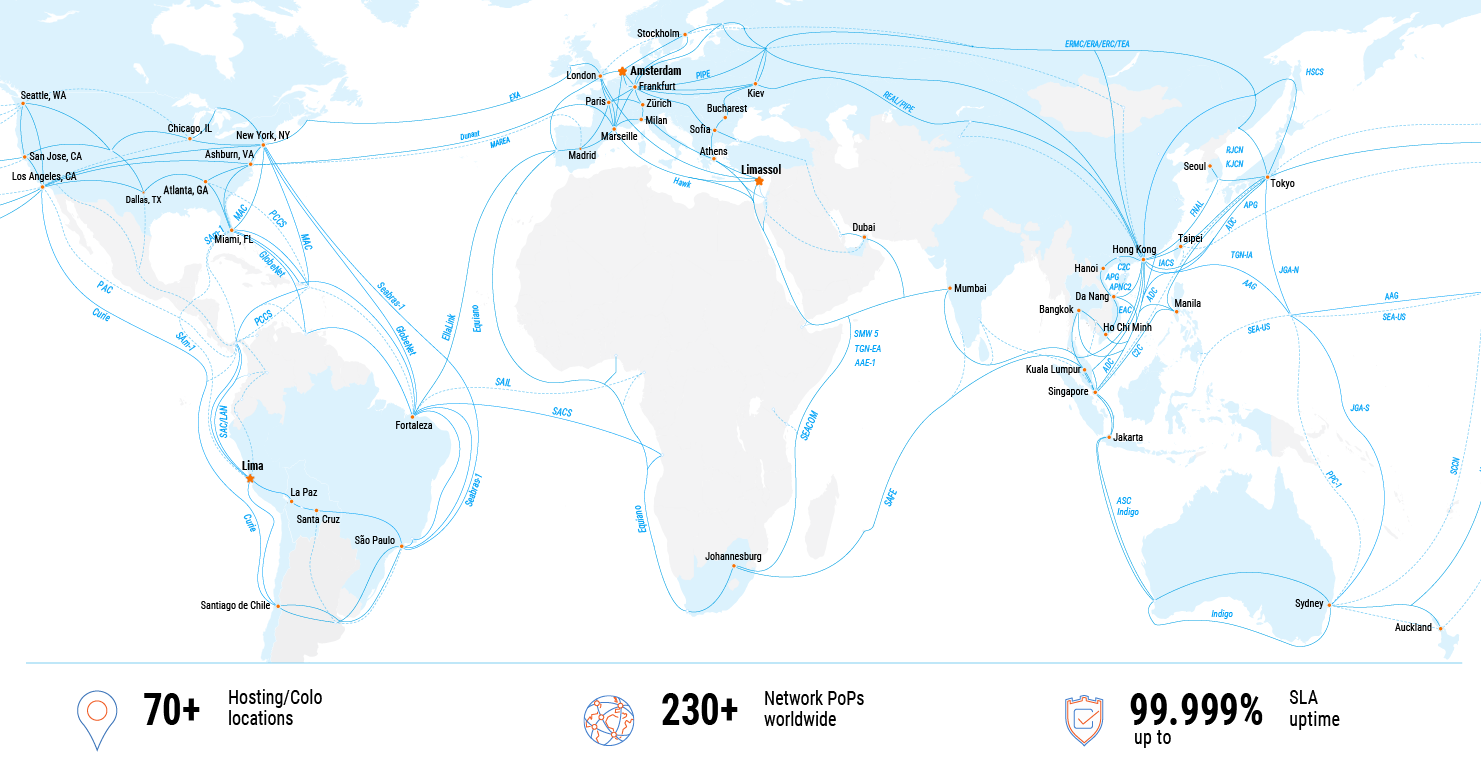
IPTP provides colocation from full cabinets to private cages across 70+ Tier III/IV locations and 240+ network PoPs, including own data centers in Amsterdam, Limassol, and Lima.
Power — the biggest variable in your quote
Power is often the largest and most variable cost in a colocation quote. Its exact impact depends on how it is billed and how much your hardware draws.
Billing models
There are two common approaches. With flat allocation, you pay for a specified capacity — say, 2 kW — regardless of whether your equipment actually consumes that amount. With metered billing, you pay for actual consumption measured in kilowatt-hours.
Flat allocation is predictable and simpler to budget. Metered billing is cheaper for low-draw hardware but produces variable costs for GPU-dense deployments.
UPS and generator backup
Redundant power infrastructure adds approximately 15–20% to the effective power cost. UPS — Uninterruptible Power Supply — is a battery system that keeps equipment running during a grid interruption until the generator starts. Generator backup extends protection through longer outages.
Modern Tier III/IV data centers are built with UPS and generator backup as standard infrastructure. This overhead is always reflected in the rack rate — it is not an optional add-on and cannot be removed from a quote.
High-density workloads
A standard 1U server draws 0.2–0.5 kW. A GPU server can draw 5–15 kW. High-density racks require engineering review before deployment: not all facilities can support the power and cooling demands.
As a reference point, a 10 kW rack at a market rate around $400/kW/month would cost approximately $4,000/month in power charges. Rates vary significantly by facility and location. Always confirm whether the quoted price includes power as a flat allocation or bills it separately by consumption.
Cooling and PUE — why the building matters
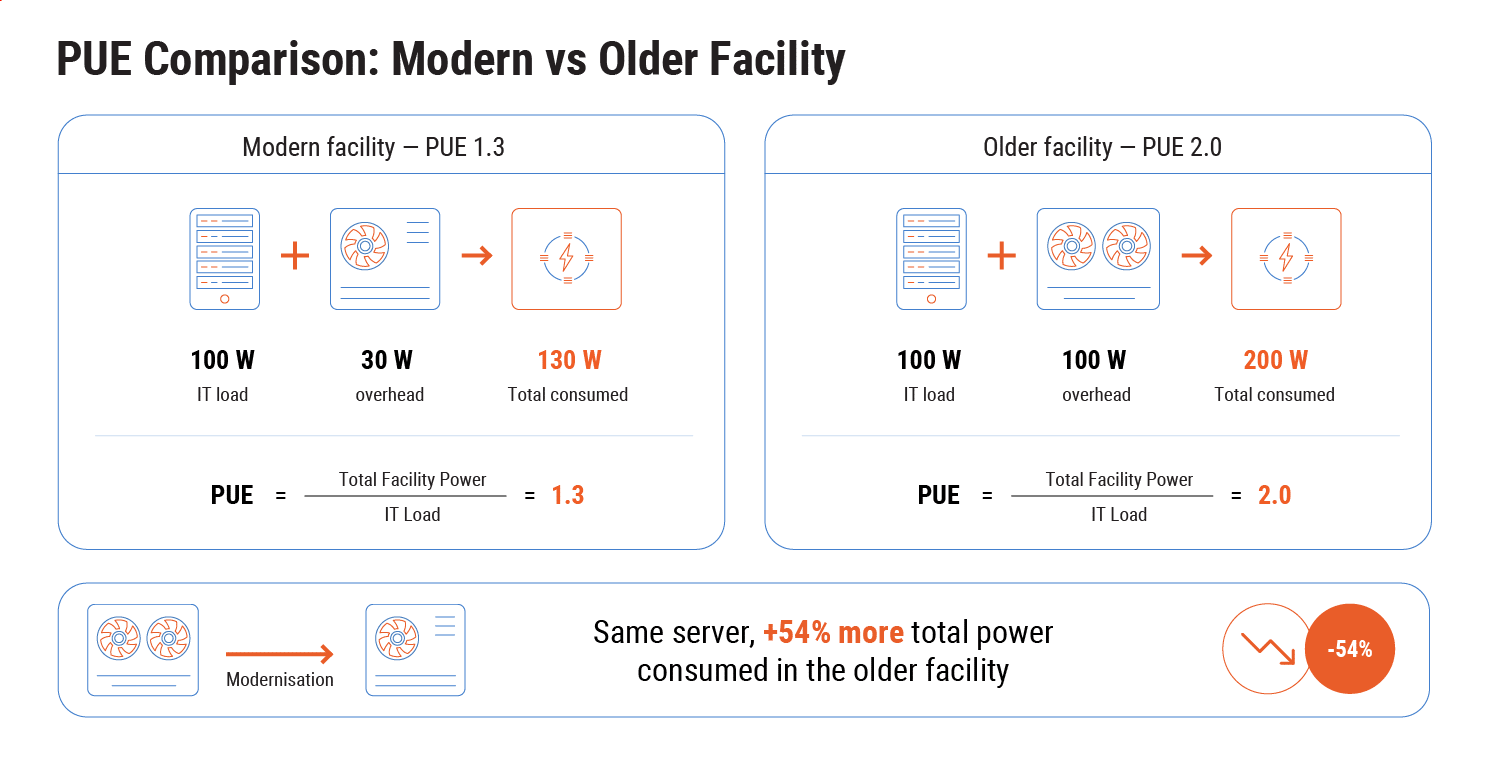
PUE stands for Power Usage Effectiveness. It measures how efficiently a data center converts total facility power into useful work by IT equipment.
PUE = total facility power ÷ IT equipment power
A PUE of 1.0 is theoretically perfect — no overhead. Modern Tier III/IV facilities typically achieve 1.2–1.4. Older facilities often run at 1.8–2.2.
The practical impact: at PUE 2.0, for every 1 W your server draws, the building uses another 1 W on cooling and supporting infrastructure. At PUE 1.3, the overhead is only 30%.
For high-density deployments — GPU clusters, AI inference workloads, trading infrastructure — cooling is the primary engineering constraint. A GPU server drawing 10 kW cannot simply be placed in a standard cold aisle without confirming the facility can handle the thermal load.
Ask your provider for the facility’s PUE rating before committing to a long-term contract.
Engineering, fire suppression and compliance
Some costs in a colocation deployment rarely appear as line items in the initial quote. They accumulate during setup and ongoing operation.
Setup fees and cable runs
Installing equipment requires physical work: cabling, patch panels, rack mounting, and labelling. These are one-time costs that vary by provider and deployment complexity. Request a written scope and cost estimate before agreeing to any setup work.
Remote hands
Remote hands refers to on-site technical support performed by the facility’s engineers on your behalf: rebooting a server, swapping a drive, checking a connection, cycling power. At Tier III/IV facilities, this service is typically billed at $150–$350 per hour, with a minimum charge of one hour. After-hours and weekend rates often differ.
Check whether remote hands is included in your SLA or billed separately.
Fire suppression
Modern Tier III/IV data centers use gas-based fire suppression — typically FM-200 or Novec 1230 — rather than water systems. These suppress fires without damaging equipment. Their presence signals a properly engineered facility. The cost is part of the facility’s operating infrastructure and is included in rack pricing.
Compliance certifications
Three certifications are most relevant to enterprise B2B deployments:
- SOC 2 Type II: covers security, availability, and processing integrity controls; requires third-party audit.
- ISO 27001: international standard for information security management systems.
- PCI DSS: required for any environment handling payment card data.
Compliance certifications apply to the entire data center facility — not to individual customers or racks. Their cost is absorbed into the facility’s operating infrastructure and reflected in the rack rate. They are not billed as a separate line item.
Always ask for the specific facility’s certification list — not the provider’s general corporate certifications, which may apply to different locations or systems. In regulated industries, a certification gap in the facility can make a deployment non-compliant regardless of the hardware in use.
When a private cage is a compliance requirement, not a luxury
For most deployments, a shared rack with logged physical access is sufficient. A private cage becomes necessary in specific scenarios — and when it does, the decision is driven by regulation or engineering, not preference.
Who needs it
Private cages are typically required by organisations operating under strict regulatory frameworks: financial services firms, healthcare operators, government and legal infrastructure, and GPU/AI deployments with high power density that require engineered cooling.
What physical isolation means
In a private cage, your equipment occupies a locked, dedicated enclosure. It is not shared with other tenants. Physical access is restricted to authorised personnel — your staff, or the facility’s remote hands team acting on your written instruction — and every access event is logged.
Custom configuration
A private cage is configured for your specific requirements: power allocation matched to your hardware draw, cooling designed for your heat output, and rack layout set by your deployment plan. This is the primary engineering cost difference from a standard shared rack.
Cost framing
The private cage premium is typically 3–5x the per-U cost of a shared rack. For organisations in regulated industries, this is almost always justified: a compliance audit failure or a security incident carries fines, remediation costs, and reputational exposure that typically exceed the cage premium by a substantial margin.
Cross-connects and connectivity — where quotes diverge most
Space, power, and cooling tend to be priced similarly across comparable Tier III/IV facilities in the same market.
Connectivity is where quotes diverge most — and the primary reason is the location and carrier history of the facility.
Two data centers at the same tier level can have very different connectivity ecosystems. A facility that has historically attracted major carriers, internet exchanges, and cloud providers costs less to connect from — because the providers are already there and compete for your traffic. A less-established facility may have fewer options, longer cross-connect lead times, and less competitive transit pricing. Location and carrier density are often the single most important factor in long-term connectivity cost.
What a cross-connect is
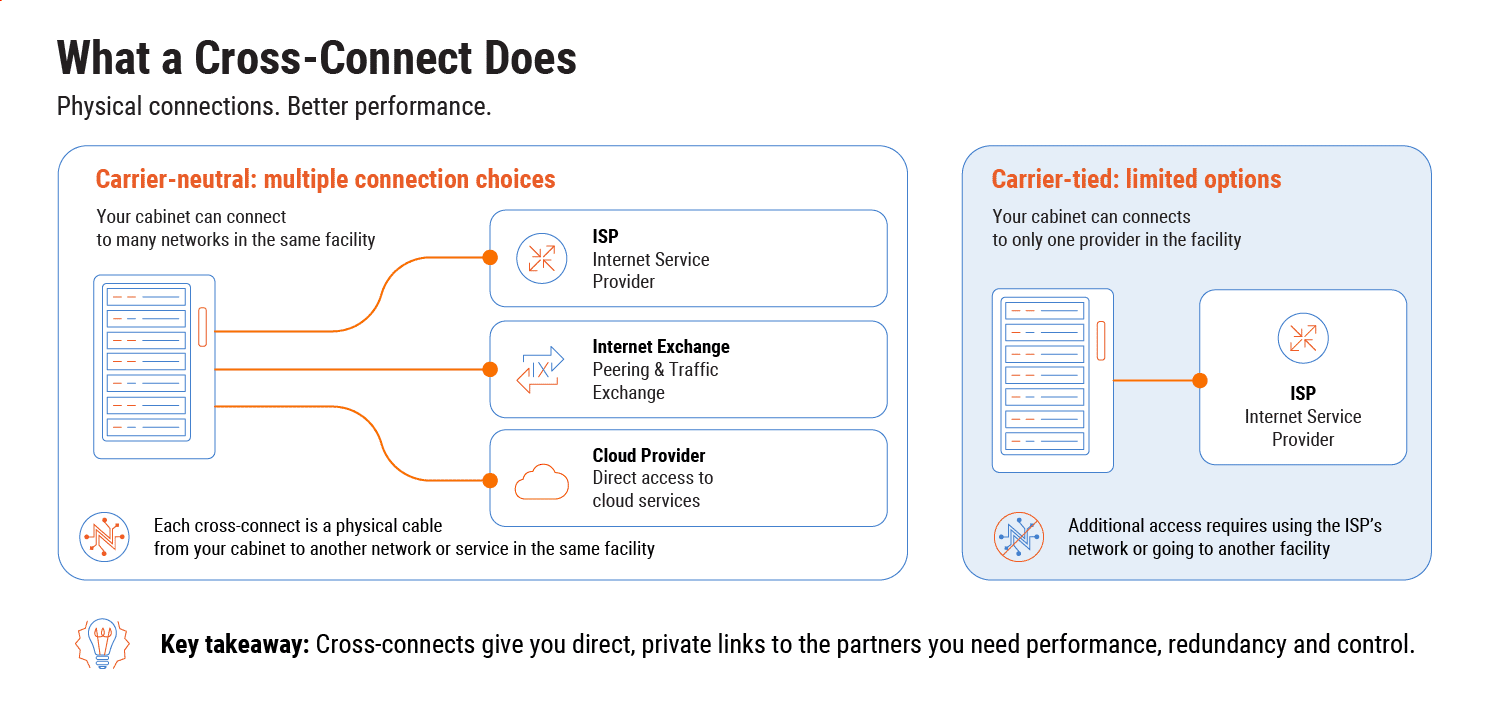
A cross-connect is a physical cable between your cabinet and another party in the same facility. That party might be a carrier, a cloud provider, an internet exchange (IX), or another tenant. Every connection to an external network — ISP, cloud on-ramp, IX — requires a dedicated cross-connect.
Two-part fee structure
Cross-connects carry two separate costs that must appear in any accurate quote comparison:
- Installation fee (one-time): typically $500–$1,500 per connection.
- Monthly recurring fee: typically $100–$300 per connection per month.
Installation fees are frequently absent from initial quotes. If a deployment requires four cross-connects, the installation alone can cost $2,000–$6,000 upfront. [1][5]
Carrier-neutral vs. carrier-tied
A carrier-neutral facility allows you to connect to any ISP, internet exchange, or cloud provider present in the building. You are not restricted to the building owner’s own network. This gives you competitive transit pricing, route diversity, and direct access to cloud on-ramps — AWS Direct Connect, Azure ExpressRoute, Alibaba Cloud, Google Cloud Interconnect — as well as multiple Internet Exchange points from a single rack.
A carrier-tied facility restricts you to the building owner’s network or a limited panel of approved providers. This limits routing options and can force higher pricing on transit and connectivity services.
Connectivity architecture — carrier neutrality, IX presence, available cloud on-ramps — is often more important to long-term operational cost than the rack rate.
IPTP Networks operates carrier-neutral colocation across its global PoP network. In locations where IPTP provides its own infrastructure, a single port can cover IP Transit, MPLS, Remote IX, out-of-band management, and other services — reducing the number of separate cross-connects a deployment requires.
How to compare colocation quotes — 10 questions to ask
Before comparing quotes or signing a contract, ask every provider these 10 questions. The answers reveal more about the true cost than the headline price alone.
1. What space format is available and what is the exact price per rack or per U?
Most Tier III/IV DCs sell minimum one full rack. Ask what the minimum unit is.
2. Is power billed as flat allocation or metered consumption — and what is the allocation or rate?
Flat is predictable. Metered suits low-draw hardware but varies for GPU workloads.
3. What is this facility’s PUE rating?
Lower PUE means lower effective power cost per kW of IT load.
4. What services are included in the quoted price versus billed separately?
Remote hands, IPv4 addresses, power monitoring, and cable management are often add-ons.
5. What cross-connect options are available, and what are the installation and monthly fees?
Get both numbers in writing. Installation fees are frequently absent from initial quotes.
6. Is the facility carrier-neutral — and which internet exchanges and public clouds are present?
Carrier-neutral + IX presence + AWS/Azure/Alibaba on-ramps = lower long-term connectivity cost.
7. What compliance certifications does this specific facility hold — SOC 2 Type II, ISO 27001, PCI DSS ?
Certifications apply to the whole facility. Ask for the facility list, not corporate certs.
8. What is the remote hands rate, and what is included in the base SLA versus billable support?
Ask whether a minimum charge applies and whether after-hours rates differ.
9. What is the minimum contract term and exit notice requirement?
Shorter terms give flexibility; longer terms often carry lower pricing.
10. Can IP Transit, DDoS protection, or private connectivity be added from the same provider?
Consolidating network services reduces cross-connect count and contract complexity.
Conclusion
Colocation quotes look different because every provider makes its own choices about what to include, how to bill power, what certifications the facility holds, and how much to charge for connectivity. The gap between two quotes for the same rack space is almost never arbitrary — it reflects real differences in infrastructure, carrier ecosystem, and commercial structure.
Once you know the six cost areas and what drives each one, a confusing quote becomes a comparison you can actually make. You know what the rack space itself costs. You know whether power is flat or metered. You know the full price of each cross-connect before you sign. You know whether the facility has the internet exchanges and cloud on-ramps your deployment needs. And you know whether a private cage is an engineering necessity for your workload or an unnecessary line item.
That is everything in the quote, accounted for. The rest is a decision.
FAQ
–
+
+
+
+
Sources
- Brightlio — Colocation Pricing in 2026: brightlio.com/colocation-pricing/
- ServerMania — 2026 Colocation Costs & Pricing Overview: servermania.com/kb/articles/server-colocation-cost
- Encora Advisors — Data Center Colocation Pricing 2026: encoradvisors.com/data-center-colocation-pricing/
- DataCenterHawk — Colocation Pricing 2026 Beginner’s Guide: datacenterhawk.com/resources/fundamentals/colocation-data-center-pricing-a-2026-beginner-s-guide
- Equinix — Cross-connect Pricing and Billing Terms: docs.equinix.com/cross-connect/xc-pricing-billing-terms/